
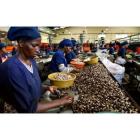













Currently, global tea cultivation covers about 60 countries and regions, while the consumer market for tea spans more than 160 countries and regions, making tea one of the most active products in agricultural trade. Today, we will focus on the status and development of the tea industry in Africa.
The world's tea production is mainly distributed in the two continents of Asia and Africa, which together account for nearly 97% of the total global tea production. The Asian region, with China, Sri Lanka and India as the main producers, contributes most of the Asian tea supply. Africa, on the other hand, has more than ten countries actively involved in tea cultivation, mainly in East Africa, with a few of them also having tea industries in the central and southern regions. The major tea producing regions in Africa include the countries of Kenya, Malawi, Uganda, Tanzania and Mozambique, which account for 91% of the total tea production in Africa.

Kenya, officially known as the Republic of Kenya, is located in eastern Africa, straddling the equator. Its geographical characteristics include an altitude of 1500 to 2700 meters above sea level, a savannah climate, year-round temperatures between 14 ℃ and 26 ℃, abundant rainfall and sunshine, so it is very suitable for the planting and growth of tea. Kenya's soil, especially the slightly acidic volcanic ash soil located on both sides of the East African Rift Valley, is particularly suitable for the growth of tea trees.
The history of tea in Kenya dates back to 1903, when the Englishman Kaina first introduced the tea plant to the Limuru region. From 1920 onwards, large-scale tea cultivation was gradually realized in Kenya, and the techniques and management concepts of tea cultivation continue to this day. In just a short period of 100 years, the tea industry in Kenya has made rapid development.
Kenya produces black tea, also known as "black tea", its tea soup shows orange-red, has a strong tea aroma and mellow taste, good quality, moderate price, so by the European and American markets. This high-quality tea makes Kenya become one of the important countries in the global production and export of tea, and is also the largest tea producer in Africa. The tea industry plays an important role in Kenya's economy and is considered one of the country's top three foreign exchange earning industries.
There are about 600,000 small-scale tea farmers in Kenya, with 100,000 hectares of tea plantations and more than 60 tea processing factories, and the number of people employed in tea production is about 5 million. Although affected by unfavorable weather factors such as drought, Kenya's tea production in 2021 will be about 800,000 tons, a decrease of about 7% from the previous year. However, tea sales are on an upward trend, with sales revenues of about KES 229 billion (about US$1.27 billion), the highest level in the past five years.

Malawi, once known as Nyasaland before independence in 1964, was a German colony. As a result, Malawi's tea is also known as "Nyasaland tea" and is the second most important tea producer in Africa after Kenya.
The main tea producing areas in Malawi are located in the south-eastern part of Lake Nyasa and on the slopes of the mountains, including Milanje, Zomba, Goro, Blantyre and other places. Tea is the second largest foreign exchange earning crop in Malawi, accounting for about 8% of the country's export earnings and contributing 7% to the Gross Domestic Product (GDP). About 60,000 people work in various segments of the national tea industry, while tea-related industries involve 1.5 million people.
Malawi's annual tea production is around 50,000 tons, with the production of black tea dominating. The black tea produced in Malawi is clear and of medium to high quality and is made from the Indian Tea Tree variety. As a result, the method of grading and production of the tea is similar to Ceylon and Indian teas. However, it is important to note that the tea tree varieties grown in Malawi are relatively low in yield and quality. Therefore, a change in the varieties of tea grown is imperative to ensure the sustainability of the tea industry.

Uganda, located in eastern Africa, is an agro-pastoralist dominated country. Agriculture accounts for 70% of Uganda's GDP and 95% of its export earnings, with tea being one of its major cash crops.
Uganda's tea-producing regions are mainly located in the west and southwest, including Toro, Ankoli, Brioro, Kigezi, Mubendi, Usaka and others. As an emerging tea producer, the Ugandan government has taken a number of measures in recent years to encourage tea farmers to expand production. They have also put in place a fairer and more rational export competition mechanism, relaxed export licensing restrictions and adopted a diversified export policy. These initiatives have attracted more companies to participate in the production and export of tea, as well as promoting foreign investment.
Uganda is primarily a producer of black tea, whose flavor is on the strong side. Black tea is often served with milk to make milk tea, a very popular combination. In addition, there is another way to drink it is to add ginger juice, which is also quite popular among the locals.

Tanzania is a famous black tea producer in Africa, and its black tea production areas are mainly distributed in the south, northeast and northwest, especially concentrated in the areas along Lake Victoria, such as Bukoba and other places. Among them, the largest production area is the southern plateau, whose production accounts for about 70% of the total national production.
Tanzania was first exposed to black tea in 1902, while commercial production began in 1926. Today, black tea is one of Tanzania's traditional export commodities. Due to its climatic conditions, Tanzania is suitable for tea production almost all year round. Tanzania mainly uses the CTC (Cut, Tear, Curl) method of tea production, with an average annual production of around 30,000 tons. However, due to climatic factors, drought and lack of rainfall may pose a threat to tea production. As a result, Tanzania is considering the introduction of new tea tree varieties from countries such as Kenya to help tea farmers increase production.
 Home
 Cart
 Favorites

 Buyer Center
 Supplier Center
 Service Center
 Help

 Publish News
